· Hernia · 2 min read
Hernia
"A hernia is an abnormal protrusion of an organ or tissue through an opening in the layer that normally confines it." According to Bailey & Love's Short Practice of Surgery
What is a Hernia?
“A hernia is an abnormal protrusion of an organ or tissue through an opening in the layer that normally confines it.” According to Bailey & Love’s Short Practice of Surgery
Causes of hernia
Anatomical weakness
Developmental failures
Genetic weakness of collagen
Sharp and blunt trauma
Weakness due to ageing and pregnancy
Primary neurological and muscle diseases
Types of Hernia
There can be two types of hernia based on whether defect is inside the body or outside the body involving skin or external environment.
External hernia(A protrusion of tissue through the abdominal wall to the outside of the body. )
Internal hernia(A protrusion of internal organs through a weakness or opening within the body’s internal cavity.)
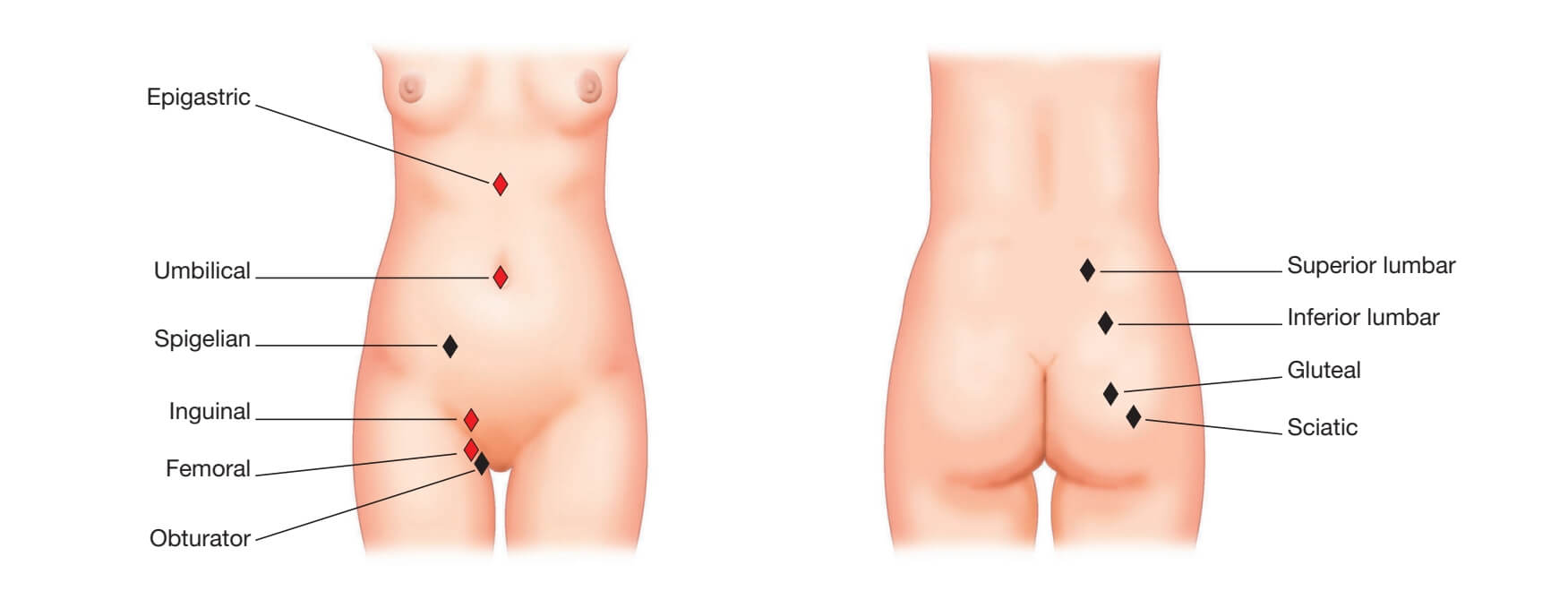
Types of External hernia
Inguinal Hernia(Through the inguinal canal)
Femoral Hernia (Through femoral canal, below inguinal ligament)
Umbilical Hernia(Through umbilical ring Common in infants)
Paraumbilical Hernia(Near the umbilicus, Seen in adults.)
Epigastric Hernia(Through linea alba between xiphoid & umbilicus.)
Incisional Hernia(Through previous surgical incision site.)
Spigelian Hernia(Through Spigelian fascia (semilunar line)Lateral lower abdomen)
Lumbar Hernia(Through lumbar triangles (Grynfeltt or Petit) Posterior abdominal wall hernia)
Obturator Hernia(Through obturator canal Elderly thin women; presents with intestinal obstruction)
Perineal Hernia(Through pelvic floor After pelvic surgery or childbirth.)
Types of Internal hernia
Paraduodenal Hernia(Most common internal hernia; small bowel herniates into a peritoneal fossa near duodenojejunal junction)
Hiatal hernia
Diaphragmatic Hernia (Congenital) Through diaphragm → stomach/intestine in thorax
Bochdalek (posterolateral) Common in neonates; respiratory distress
Morgagni (anteromedial) May be asymptomatic or cause obstruction
Anatomy

There are following layers in abdomen from outside to inside
Skin
Camper’s fascia
Scarpa’s fascia
External oblique aponeurosis
Internal oblique aponeurosis
Transversus abdominis muscle
Transversalis fascia
Extraperitoneal fascia
Parietal peritoneum
Symptoms
Common symptoms include a noticeable lump, pain or discomfort (especially when bending or lifting),
and a heavy feeling in the abdomen. In some cases, hernias may not cause noticeable symptoms.
Causes and Risk Factors
Hernias can develop due to muscle weakness, aging, heavy lifting, chronic coughing,
obesity, or previous surgeries. Both men and women can experience hernias, though
certain types are more common in one gender.
Treatment Options
While small hernias may not require immediate treatment, surgery is often recommended
to prevent complications such as strangulation (when blood supply to the tissue is cut off).
Prevention Tips
Maintain a healthy body weight.
Avoid lifting heavy objects improperly.
Eat a high-fiber diet to prevent constipation.
Exercise to strengthen abdominal muscles.
Stop smoking to reduce chronic coughing.
References:-
Bailey & Love’s Short Practice of Surgery
Gray’s Anatomy